Total Productive Maintenance (TPM): The 8 Pillars Explained
TPM and RCM both aim at more reliable equipment, but they answer completely different questions — one is a plant-wide culture, the other an asset-by-asset analysis. The 8 pillars of TPM, autonomous maintenance, and how OEE is calculated.
July 22, 2026 ·
Updated July 22, 2026 ·
5 min read ·
SCMEP Training Team ·
222 views
Share
TPM and RCM both aim at getting more reliable equipment, but they answer
completely different questions. RCM asks “what strategy does this
specific asset need?” TPM asks “how do we build a plant-wide culture
where everyone owns equipment reliability?” Neither replaces the other.
Where TPM came from
Total Productive Maintenance traces back to Seiichi Nakajima’s work in
Japan starting in the 1950s-70s, with Nippondenso — a Toyota-group parts
supplier — formally applying the framework and winning Japan’s PM Prize
in 1971. The Japan Institute of Plant Maintenance (JIPM) later
established itself and expanded the framework into what’s now known as
the 8 pillars.
The 8 pillars
The 8 pillars of Total Productive Maintenance
Pillar
Focus
Autonomous maintenance
Operators handle basic cleaning, inspection, and lubrication themselves
Planned maintenance
Scheduled maintenance based on predicted failure patterns
Quality maintenance
Preventing defects by controlling equipment conditions
Focused improvement
Small cross-functional teams solving specific chronic losses
Early equipment management
Designing maintainability into new equipment before it’s installed
Education and training
Building the skills the other pillars depend on
Safety, health, and environment
Zero-accident, zero-harm target built into daily routines
TPM in administration
Applying the same waste-elimination thinking to office and support functions
Autonomous maintenance — the pillar that defines TPM
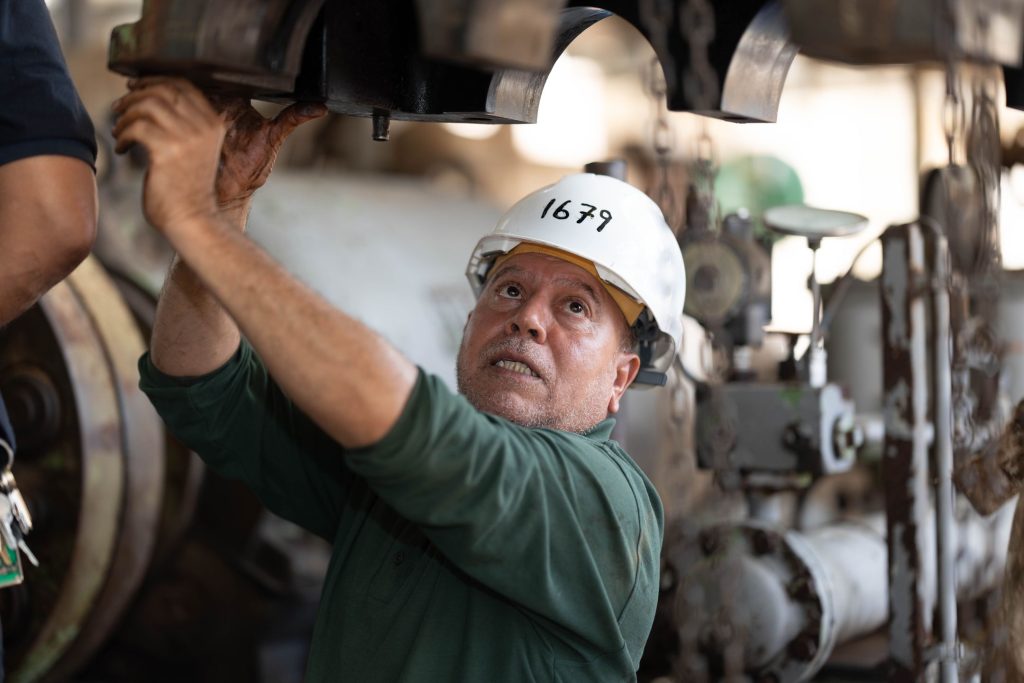
Autonomous maintenance shifts routine cleaning, inspection, and
lubrication from a dedicated maintenance department to the operators
running the equipment every day. That’s a genuine culture shift, not
just a task reassignment — it puts detection in the hands of the person
closest to the asset, who’s most likely to notice a developing problem
first, and frees skilled maintenance technicians for the higher-value
repair and analysis work only they can do.
The shift isn’t just about who cleans the machine. An operator who
regularly inspects and lubricates their own equipment develops a feel
for how it’s supposed to sound and run, which makes them far more likely
to notice a developing problem — a new vibration, a slight temperature
change — before it becomes a breakdown. That early-detection effect is
arguably the bigger payoff of autonomous maintenance, not the labor
reallocation itself.
OEE: the metric TPM is measured against
Overall Equipment Effectiveness (OEE) is calculated as Availability
× Performance × Quality — a single number capturing how much
of a machine’s theoretical capacity actually turns into good output.
There’s no single universally agreed “world-class” OEE percentage worth
treating as gospel; the more useful practice is tracking your own OEE
trend over time and tying specific pillar activities to specific losses
(availability losses point toward planned maintenance gaps, quality
losses point toward quality maintenance gaps, and so on) rather than
chasing a borrowed benchmark number.
Where TPM actually stalls
The most common failure pattern with TPM rollouts isn’t resistance
to the idea — it’s launching all 8 pillars at once across the whole
plant, which spreads training and attention too thin to build real
habits anywhere. Programs that stick usually start with autonomous
maintenance on one line or one piece of equipment, prove out the routine
with real operator buy-in, and expand from that proof point rather than
mandating the full framework everywhere on day one.
TPM vs. RCM
Two maintenance frameworks that work at different levels
TPM
RCM
Nature
Plant-wide operational philosophy and culture
Analytical, per-asset decision process
Unit of analysis
Whole plant or production line
Individual asset or failure mode
Who’s involved
All employees, especially operators
Reliability and engineering team
Starting question
How do we prevent losses and build ownership plant-wide?
What does this asset need to do, how does it fail, and what strategy fits?
They’re complementary layers rather than competitors — see our
related article on
Reliability Centered Maintenance for the asset-level decision process
TPM’s culture sits on top of. A plant with strong TPM culture but no RCM
analysis might have engaged operators doing daily checks on equipment
that’s still on the wrong maintenance strategy entirely; a plant with
rigorous RCM but no TPM culture might have the right strategy on paper
with no one on the floor actually invested in executing it day to day.
TPM’s culture is measured against a specific metric. See our related
guide on Overall
Equipment Effectiveness for the formula, and why the “85% world
class” benchmark gets oversold.
TPM is a maintenance philosophy; SMRP certifies the people who carry it out. See our related guide on SMRP and the CMRT certification for the credential built around maintenance and reliability skills.
Frequently asked questions
What is Total Productive Maintenance?
TPM is a plant-wide operational philosophy, originating in Japan in the 1950s-70s, built around involving all employees — especially operators — in equipment reliability through practices like autonomous maintenance, organized into 8 pillars.
What are the 8 pillars of TPM?
Autonomous maintenance, planned maintenance, quality maintenance, focused improvement, early equipment management, education and training, safety/health/environment, and TPM in administration.
How is OEE calculated?
Overall Equipment Effectiveness equals Availability multiplied by Performance multiplied by Quality — a single metric capturing how much of a machine’s theoretical output capacity actually becomes good product.
What’s the difference between TPM and RCM?
TPM is a plant-wide culture and philosophy involving all employees in equipment reliability. RCM is an analytical process for deciding the right maintenance strategy for each individual asset based on its specific failure modes. They’re complementary, not competing, frameworks.
South Carolina Manufacturing Extension Partnership has delivered manufacturing training to South Carolina manufacturers since 1989. Articles are produced and reviewed by SCMEP's training team.